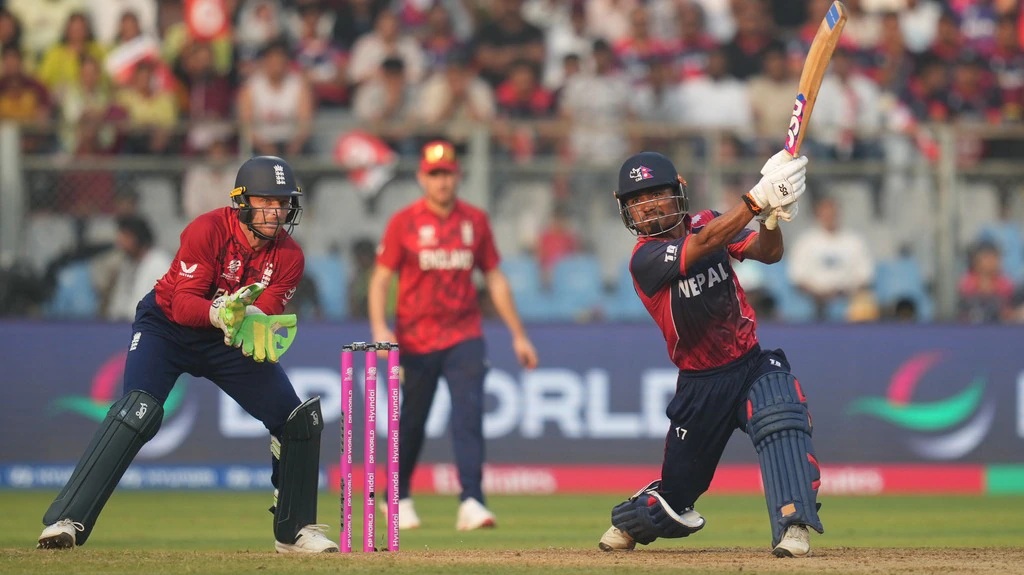
Nepal head coach Stuart Law has warned his players about the distractions of social media and urged them to refocus on their cricket as they attempt to keep their T20 World Cup campaign alive.
Nepal sit bottom of Group C after a narrow defeat to England and a heavy loss to Italy and must beat West Indies in a crucial match in Mumbai. Law said the drop in performance between those games needed addressing.
“I think the way that we’ve got to look at it now is we’ve got to work out why the gulf from the England game to the Italy game happened,” Law said in Mumbai a day before their must-win against West Indies.
“I think if the Nepalese people in the room here, I think they will understand that social media is a massive part of the Nepalese culture. To me, social media can be a huge distraction. If you’re focusing on what you’re doing on social media, if you’re focusing on what people are saying about us on social media, and not focusing on what the team needs, the team-mates are saying, and the game requires, you’re distracted from your actual job.
“It’s a difficult one because I know a lot of the players, they rely on it to gain endorsements and sponsorship, etc. But I think also that at World Cups, cricket is the main thing. I’ve tried to explain to them that if we keep winning games of cricket, your likes will go up anyway.”
Law added that the defeat to Italy, four days after pushing England to the brink, highlighted a lack of resilience.
“You don’t have to keep showing your face if you show that cricket in Nepal is going forward and we’re winning games of cricket. Your attraction on social media will go through the roof. It’s a difficult one for me because I’m a social media dinosaur, I don’t understand it. I know the negative impact it can have, but I don’t quite understand the positive impact.
“So I’m being educated on this as well, and trying to strike a happy medium with the players, to make sure they’re focused on their cricket, number one, and the rest of the nonsense that I call it – I’ve said that to the boys today – take that away from cricket, do it away from cricket. When you’re in cricket, do your cricket.”
“To go from that high to then go to an extreme low four days later, that’s not showing mental toughness,” Law said. “It’s not showing commitment to your team, to your country, to your family, to your team-mates. So we need to make sure that we understand that we need to do that better, and how we address that from now on needs to come from good conversations, positive conversations. But also, don’t just say you can’t do it. Pick and choose the times that you do it properly.”
Nepal must now beat West Indies and Scotland to keep their hopes alive after failing to build on their strong showing against England.
Law also highlighted structural challenges facing Associate nations and the need for stronger domestic pathways.
“First and foremost, we need a proper domestic structure, which I know that talking to CAN, the people involved in the cricket-making decisions, constant conversations are going on about how we can create a first-class structure that’s why the Test nations are as good as they are,” Law said. “They have pathways from very young ages right through to the senior national men’s and women’s team.
“To replicate that is going to take a lot, and unfortunately it takes a lot of money to make it happen. So we need to find a way how we can maybe take parts of a structure and implement it into our cricket. Finding the time, finding the grounds to be able to do so.These things will take time.
“But when you say there’s a big gulf, of course there is. There’s always going to be a gulf between the Test nations and the Associates, but it doesn’t mean the Associates aren’t good players and it doesn’t mean that they can’t beat the bigger teams as well. I think we’ve proven that over the last couple of months, the last couple of World Cups, there’s been upsets in a way, and that’s great for cricket, but doing it once is not enough. We’ve got to do it over and over again to really make noise with the right people to come in and help us.”
Law said Nepal had benefited from last year’s Top End T20 series and the launch of the Nepal Premier League, which he believes will help develop players and funding.
“The way that cricket in Nepal is building, the NPL is really helping us now,” Law said. “That will help generate funds but also help generate better players underneath this group. So we’re a couple of years away from seeing the real benefits and the role that that will play in our success in the future. And hopefully from the NPL we also can get a multi-day format started because I think the longer formats is where you learn how to play the game. The shorter formats is where you have your fun. So we can get a multi-day format being played as well.”
Nepal are playing all four of their group matches in Mumbai and Law admitted he would have preferred conditions in Sri Lanka, even while praising the iconic Wankhede Stadium.
“No disrespect to India, but I wish we were in Sri Lanka with the wicket turning the way it is,” he said. “If there’s a bit of turn on the wicket consistently for the whole game, I think we’d utilise our skillset a lot better. But having said that, to be here at the Wankhede every game, you can’t beat it. It’s a beautiful ground to play at, it’s one of the most iconic venues in world cricket. To be lucky to stay here, I think with the travel, etc., it takes that element out of it. You don’t have to pack up, move on and keep doing it. That can be tiresome.
“But there is positives if we had to go elsewhere to play on bigger grounds, like if we’re playing at the Premadasa, it’s a bigger ground and that suits us. We can use our speed between the wickets. We can use our spin bowlers more effectively. Here, it’s 70 metres all the way around. If you don’t get it right, you’re in the top tier.”
Nepal will face Scotland in their final group stage game on 18 February at Wankhede Stadium.